Domain Scan Results
Scan a domain from the outside, the way an attacker would see it, and get a clear list of website, email and DNS issues to fix.
What the page is for
The Domain Scan Results page runs a non-intrusive external scan of a domain and its subdomains and shows what it found. It checks open ports and services, website security headers, encryption and certificates, email and phishing protection (such as SPF and DMARC), the software components and content management system a site runs, performance, and domain and DNS settings, and whether a web application firewall is in front of the site.
Results are summarized in plain language with the business risks they create, counted by area (Email, Web, Domain, Admin, Encryption, Ports and WAF) and compared with the median of other scanned domains. Scanned domains are kept as monitored domains for the selected company, so you can come back to them, download reports and have results emailed after each scan.
What you see
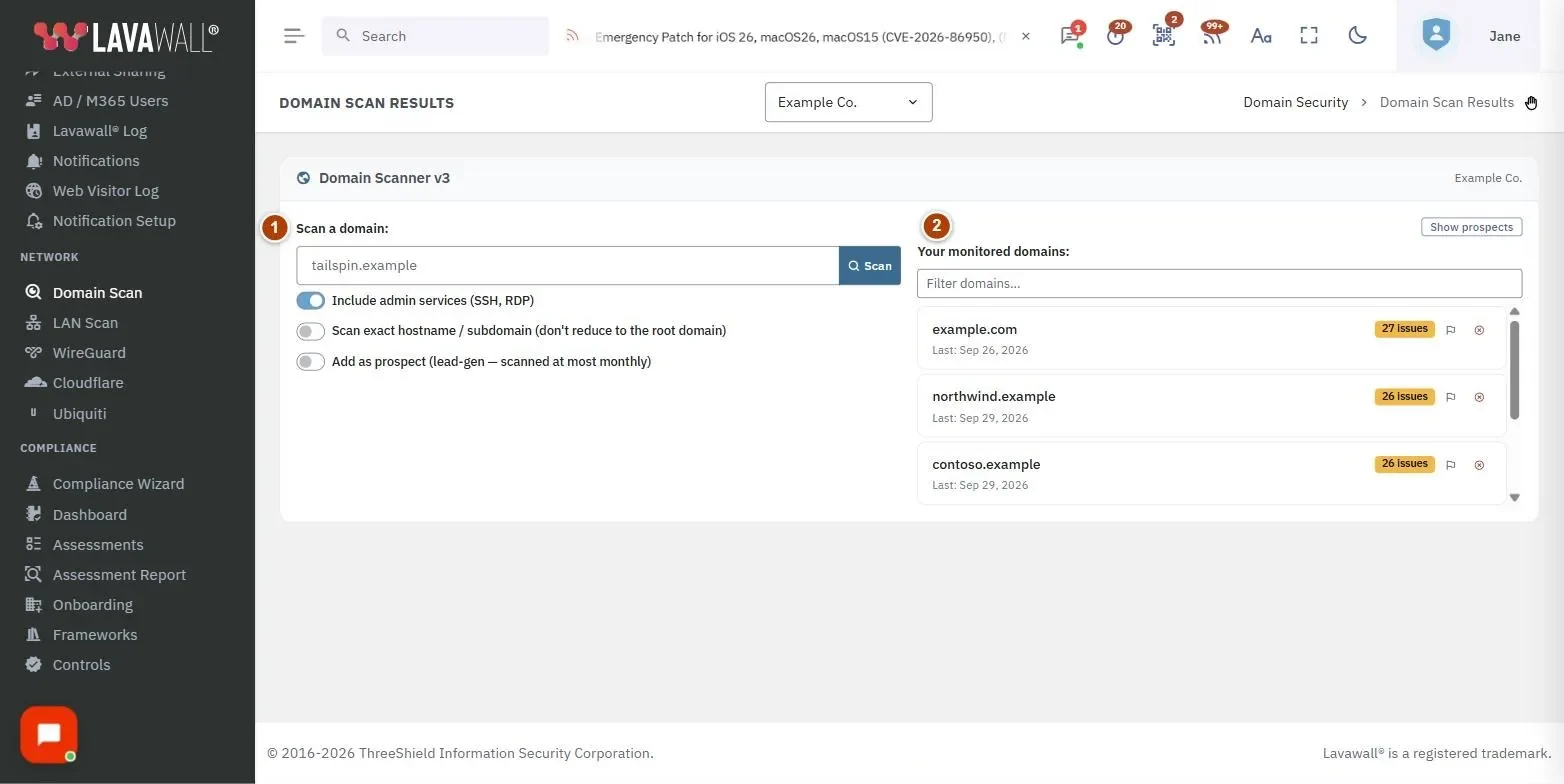
- Scan a domain: the domain box, Scan button and options.
- Your monitored domains: each domain with its issue count, last scan date and badges such as No DMARC, No SPF or No TLS.
- Scan Overview: progress, PDF Report, Word Report and Email Reports, a plain-language summary, business risk context and issue counts per area.
- Findings and comparison chart: the list of issues to fix, a chart comparing this domain with the median (smaller is better), and short explainer videos.
- Technical Details: Open Ports & Services, Web Security & Headers, Subdomain Services, Encryption, Email & Phishing Protection, Components, Performance and Domain & DNS.
How to use Domain Scan Results
How to scan a domain
- Select the company the domain belongs to.
- Type the domain in Scan a domain (for example example.com). Web addresses are trimmed to the domain automatically.
- Leave Include admin services (SSH, RDP) on to also check for exposed administrative services.
- Turn on Scan exact hostname / subdomain to scan, for example, a staging site exactly as typed instead of the main domain.
- Click Scan and watch the progress bar. Sections fill in as results arrive.
How to review an existing domain
- Click the domain in Your monitored domains. Use Filter domains… when you have many.
- Read the summary and business risk context first, then the area counts.
- Open Technical Details for the evidence behind each issue.
How to share results
- Click PDF Report or Word Report to download a report.
- Click Email Reports, enter an address, choose Only when new issues found or Every scan, and click Add.
- Click Send now to email the current results to all recipients straight away.
How to remove a domain
- Click the remove button next to the domain in Your monitored domains.
- Confirm Remove domain?. This only removes the company association; scan data is kept.
Tips
- Issue badges are green for 5 or fewer, blue up to 20, amber up to 50 and red above 50.
- In the comparison bar, red is your issues, green is the remainder and ▲ marks the median.
- Only scan domains you are authorized to scan. Some well-known domains cannot be scanned.
- Click Show prospects to include prospect domains, which are hidden by default for faster loading.
Troubleshooting
- "Invalid Domain". Check the spelling and enter a domain, not an email address.
- "Scan is taking longer than expected." Large sites take a while. Wait, or try again.
- "No domains monitored yet." Scan a domain above to get started.
- "Your session token was out of date." Reload the page and try again.
Task guides that use this page
Related articles
Still need help?
Search the support centre, or contact our support team and tell us which page you were on.
Names, companies, devices and figures in the pictures are examples. Other product and company names are trademarks of their respective owners.