Business Impact Assessment
Know what your business truly depends on.
Lavawall® runs your Business Impact Assessment in plain language, building on the security and IT data you already collect, so you learn how long each critical process could really survive an outage before you find out the hard way. A BIA used to mean a consultant, a spreadsheet, and a week of interviews.
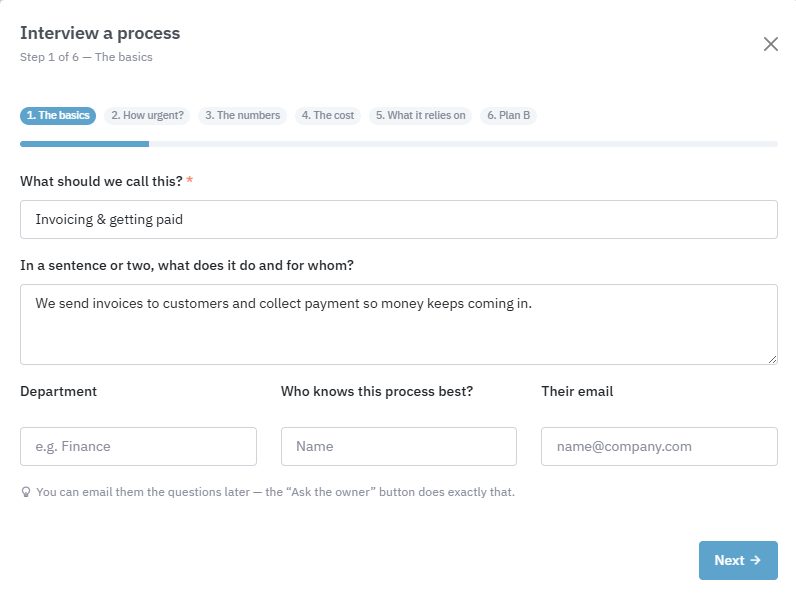
There is no jargon, no RTO and RPO acronyms to decode, and no login for the stakeholders you interview. Simple questions like “How long could you keep working if this went down?” turn into an audit-ready report.
Start with the GRC Wizard See the full GRC platform
Plain-language interview · RTO/RPO set for you · downtime heatmap · dependency maps · gap analysis
Built on data you already collect
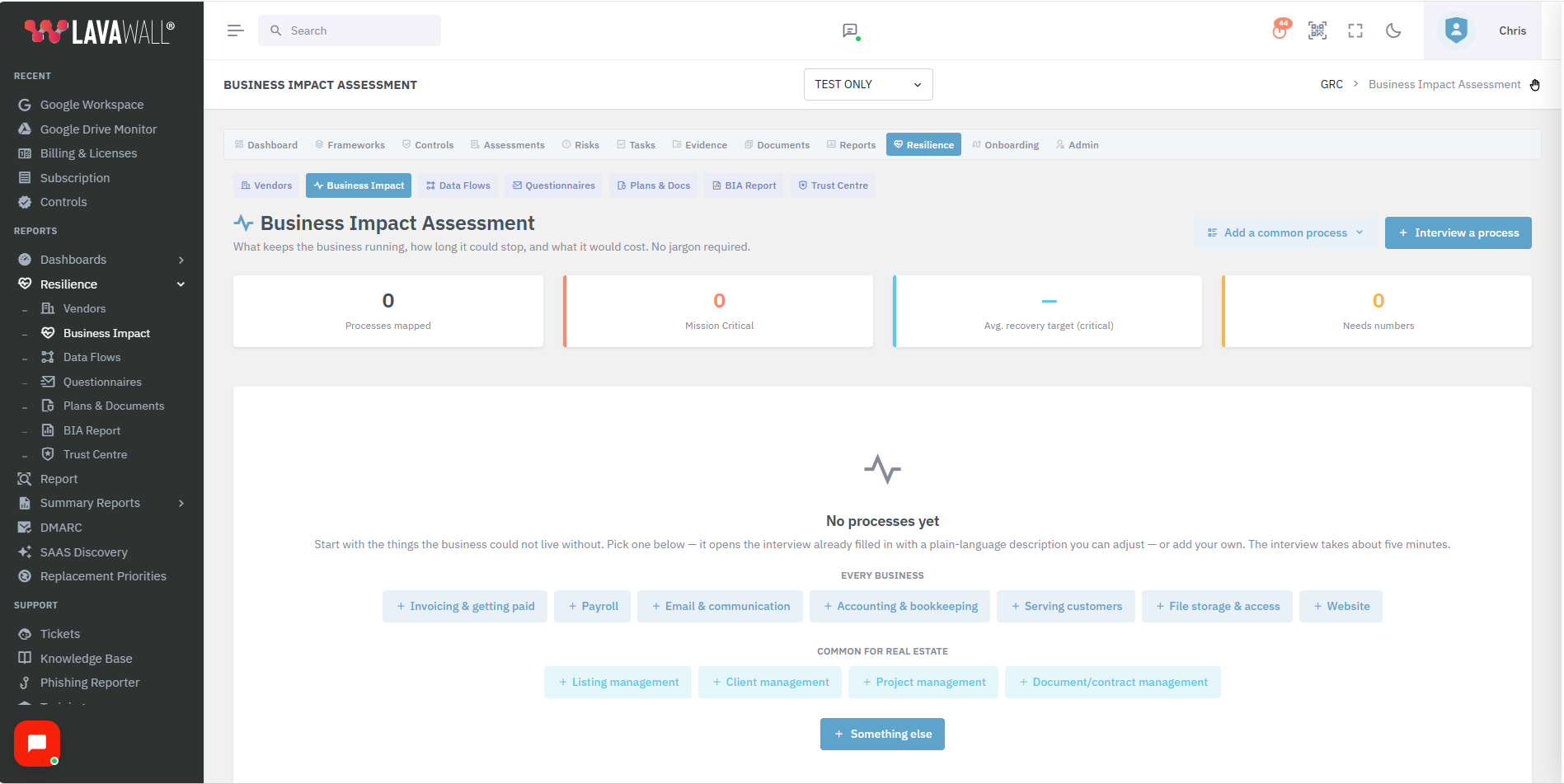
Most BIA projects start from a blank page and someone's memory. Lavawall starts from what it already knows. The vendors, systems, and people it sees across your connected security and IT tools are pre-filled as candidate dependencies, so the interview is about confirming and prioritizing, not typing from scratch.
Two themes run through the whole assessment
First, it reuses the security and IT data you already collect, so the picture is grounded in reality instead of guesswork. Second, every question is plain language that any stakeholder can answer, with no jargon and no login required. That is what makes a BIA finally get finished.
Interviews anyone can complete
Lavawall asks the people who run each process what they actually experience. “How long could you keep working if this went down?” “What would you lose if it failed at month-end?” The answers become recovery targets and impact ratings automatically.
Recovery targets, set for you
You never have to define RTO or RPO. Lavawall derives how quickly each process must come back and how much recent work you could afford to lose, straight from the plain answers your team gives.
Impact that grows over time
An outage that is a nuisance at one hour can be an existential threat at three days. Lavawall captures how the impact of downtime escalates, so recovery priorities reflect real business risk, not gut feel.
Dependencies mapped, not guessed
Each critical process is linked to the vendors, systems, and people it relies on, drawing on the SaaS apps Lavawall detects and the tools it already connects to. You see the chain of dependence behind every process at a glance.
A report an auditor or insurer will accept
When the interviews are done, Lavawall assembles a professional Business Impact Assessment, ready to print or hand over.
Executive summary
A one-page view leadership can read in a meeting, no security background required.
Downtime impact heatmap
See at a glance which processes hurt most, and how fast, when they stop.
Dependency maps
Each process linked to the vendors, systems, and people that keep it running.
Automatic gap analysis
Where recovery targets outrun your current ability to meet them, flagged for you.
Your BIA fills in the documents that follow
The BIA is the source of truth the rest of your resilience documents draw on. Once it is done, Lavawall® uses data you already have to auto-fill each of these in plain language, carrying priorities, recovery targets, systems, and vendors straight across.
- Continuity & incident plans · your incident response, disaster recovery, and business continuity plans, with critical systems, vendors, and RTO/RPO priorities pulled from the BIA.
- Foreign Processing Disclosure · where your data leaves the country, paired with the right privacy-law notices.
- Data Flow Documentation · how information moves between the systems your BIA maps as dependencies.
- Privacy Policy addendum · your service providers, AI use, and international processing, tied together in one addendum.
Part of the wider GRC platform
Vendor Inventory
The vendors your BIA depends on, discovered and assessed automatically from the tools Lavawall detects.
Build it automatically →GRC & compliance
Map your controls to frameworks, generate policies, and keep evidence current alongside your BIA.
Learn more →GRC Wizard
The plain-language wizard that runs your BIA, vendor reviews, and compliance mapping start to finish.
Open the wizard →Common questions
- What is a Business Impact Assessment (BIA)?
- A BIA is a review that identifies the processes your business depends on, how quickly each must recover, and what a disruption costs over time. Lavawall captures this through a plain-language interview and turns it into a professional report for auditors, insurers, or leadership.
- Do I need to be technical to complete it?
- No. The wizard asks plain questions like “How long could you keep working if this went down?” Any stakeholder can answer, with no jargon and no login required, and Lavawall converts the answers into recovery targets and impact ratings.
- What are RTO and RPO, in plain terms?
- RTO is how long a process can be down before it really hurts. RPO is how much recent work you could afford to lose. Lavawall sets both from simple questions, so you never define the acronyms yourself.
- Does the BIA reuse data I already have?
- Yes. It draws on the systems, vendors, and people already visible across your connected security and IT tools, so dependencies are pre-filled. You confirm and adjust rather than start from a blank page.
- What does the final report include?
- An executive summary, a downtime impact heatmap, dependency maps, and an automatic gap analysis, ready to print or hand to an auditor or insurer.